
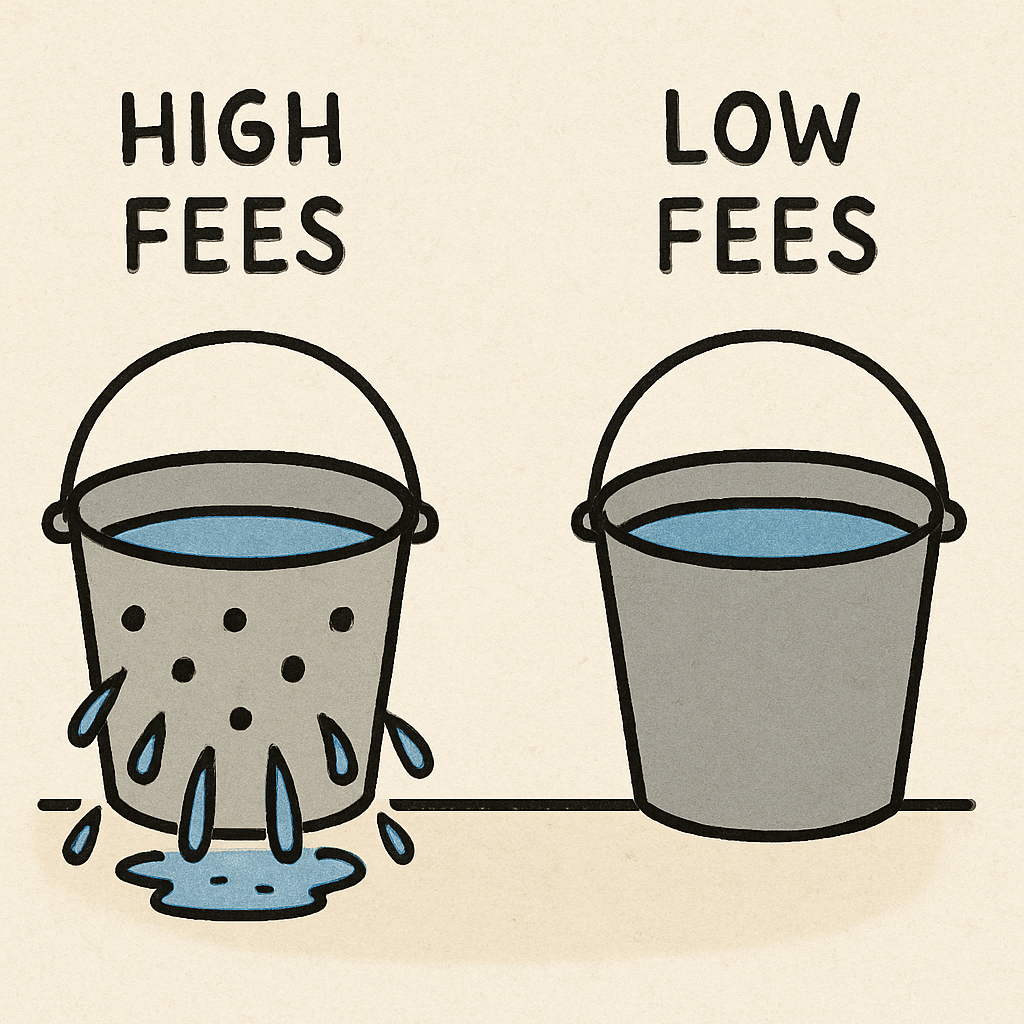
Imagine filling a bucket with water to save for a dry season, only to discover a tiny hole hidden in the bottom. You barely notice the drip at first, but over twenty years, half your water vanishes into the dirt. That hidden leak perfectly illustrates how high investment fees secretly drain your hard-earned savings.
Nobody can predict what the stock market will do tomorrow, but your costs are entirely within your control. Financial industry data consistently shows that a seemingly tiny 1% yearly fee equals years of lost retirement income. Think of this charge, formally called an expense ratio, as a mandatory “maintenance fee” the fund takes just for keeping the lights on.
Buying low-cost ETFs acts like patching that hole in your financial bucket. By focusing on minimizing investment fees, you keep almost all of your money working for you instead of paying a fund manager’s salary. Running a quick expense ratio comparison between funds is the absolute easiest way to tell if you are securing a genuine value or just an overpriced label.
The ETF Fruit Basket: Owning 500 Companies for the Price of One
Buying a single stock is like buying one apple. If that apple is bruised, your money is wasted. Instead, imagine grabbing a massive, pre-packaged fruit basket. That basket is an ETF (Exchange Traded Fund). By purchasing just one share of this fund, you instantly own tiny slices of hundreds of different companies at once.
Spreading your money around like this is called diversification. It protects you if a single business goes bankrupt, because the other companies in your basket can still thrive. This is why total stock market tracking is so popular—rather than guessing which specific business will win, you are simply betting on the overall economy growing.
Consider the contrast between picking 10 separate companies versus grabbing one fund:
- Time: Researching individual stocks takes hours; buying one ETF takes seconds.
- Risk: Ten stocks rely on a few CEOs; a single fund spreads risk across hundreds.
- Cost: Using low-cost exchange-traded funds is significantly cheaper than buying individual pieces.
Nailing down diversification for beginner investors used to require a pricey broker, but today it is effortless. Yet, not all baskets are priced fairly. Before clicking “buy,” you must verify the maintenance charges attached to them, as a seemingly small 1% fee can steal 30% of your future returns.
The Brutal Math of Fees: How 1% Steals 30% of Your Future
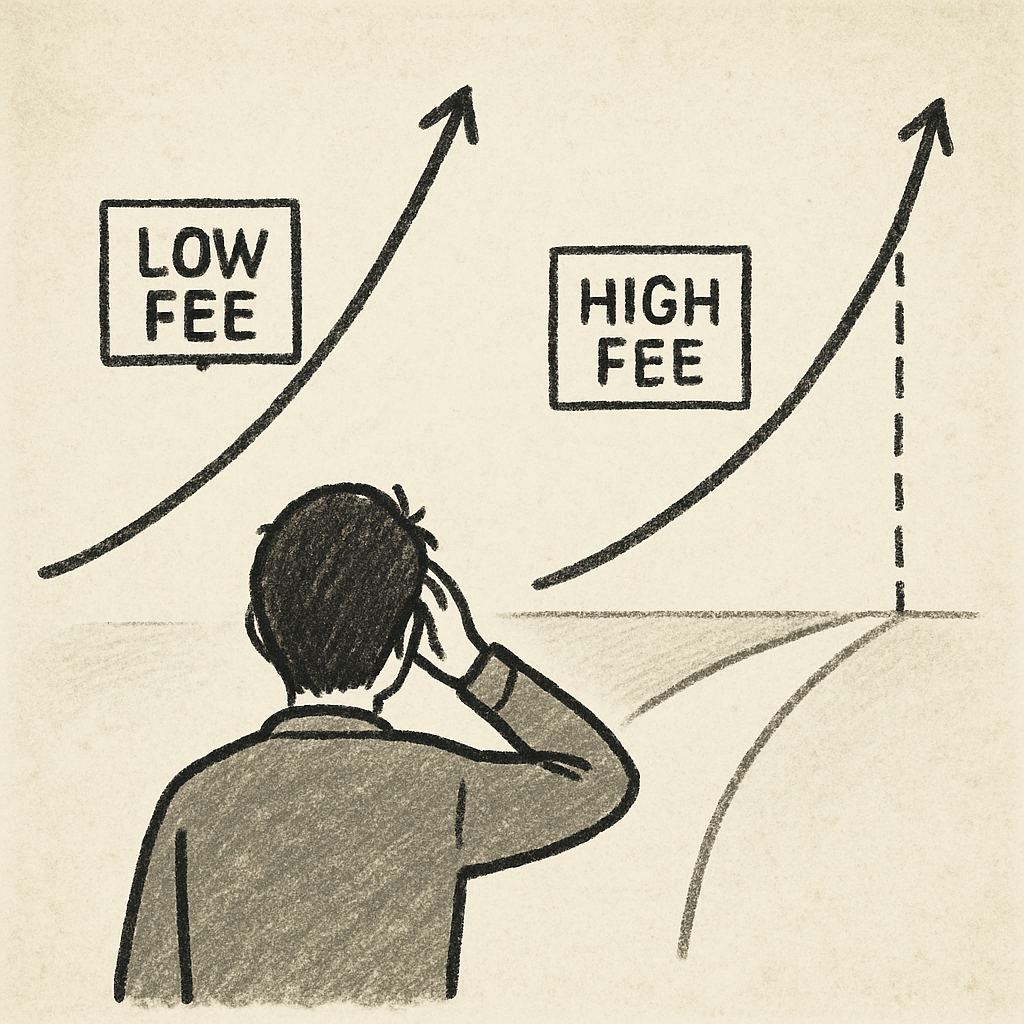
A 1% maintenance fee acts exactly like that hidden leak in your bucket, silently draining a massive portion of your savings over time. This compounding drag—where your money loses the chance to grow on top of itself—consumes tens of thousands in potential returns compared to a fund charging just 0.05% (or 5 “basis points,” meaning five-hundredths of a percent).
Protecting your future wealth means always checking a fund’s price tag. Smart shoppers hunt for the lowest expense ratios available, ensuring every saved dollar stays in their account to multiply over time. Whether you choose modern ETFs or traditional low-cost mutual funds, keeping these underlying fees near zero remains the absolute gold standard for reliable financial growth.
Expensive funds try to justify their steep prices by promising incredible, market-beating returns, yet they rarely succeed. Even when weighing minor technical issues like the impact of tracking error—when a fund slightly misses perfectly matching its market target—high fees remain the single largest, guaranteed threat to your portfolio. This mathematical reality prompts a vital question: why pay an expensive chef to pick your food when you can just buy the standard grocery list?
Chefs vs. Grocery Lists: Why Passive Management Usually Wins
Hiring a professional to handpick your investments is called active management. Think of this like paying a luxury chef to select your groceries. Conversely, passive management simply buys a pre-set list of top companies. When comparing passive vs. active management, you might naturally assume the expensive expert delivers better results. Surprisingly, paying for effort rarely equals maximum profit in the financial world.
Wall Street experts measure their success against a “benchmark,” which is simply a standard, unmanaged list of stocks. Statistically, the high-priced chefs almost always lose to this basic list over time. This consistent failure happens for three straightforward reasons:
- High management salaries immediately eat into your baseline profits before you make a dime.
- Human managers make emotional trading mistakes when markets panic.
- Constant buying and selling creates hidden transaction costs, making minimizing investment fees impossible.
Because active managers must constantly outsmart the market just to cover their own high costs, simply buying the entire basket and leaving it alone is statistically superior. Beyond just avoiding high salaries, this passive approach offers another incredible advantage: trading less frequently actively shields your wealth from the IRS.
The Invisible Bonus: Why ETFs are More Tax-Efficient Than Mutual Funds
Imagine sharing a dinner bill where you must pay taxes for a stranger who left early. Traditional mutual funds operate exactly like this. When other investors cash out, the manager must sell underlying stocks to pay them. This action triggers sudden tax bills that get passed directly to everyone remaining in the fund. You end up owing the IRS for someone else’s financial decisions, exposing one of the worst hidden costs of trading.
Exchange-Traded Funds solve this unfair trap entirely. When someone sells their ETF shares, they simply trade them to another buyer on the open market. The fund manager never touches the underlying basket of stocks, meaning there are no forced sales and no shared penalties. This mechanical advantage drives the superior tax efficiency of exchange-traded funds, ensuring your savings remain safely insulated from other people’s panic.
Keeping the government at bay makes these investments perfect for standard brokerage accounts. By combining built-in tax protection with minimal fees, low-cost ETFs let your money compound uninterrupted. The crucial next step is finding funds with the right price tag.
How to Spot a Winner: Reading the ‘Unit Price’ of a Fund
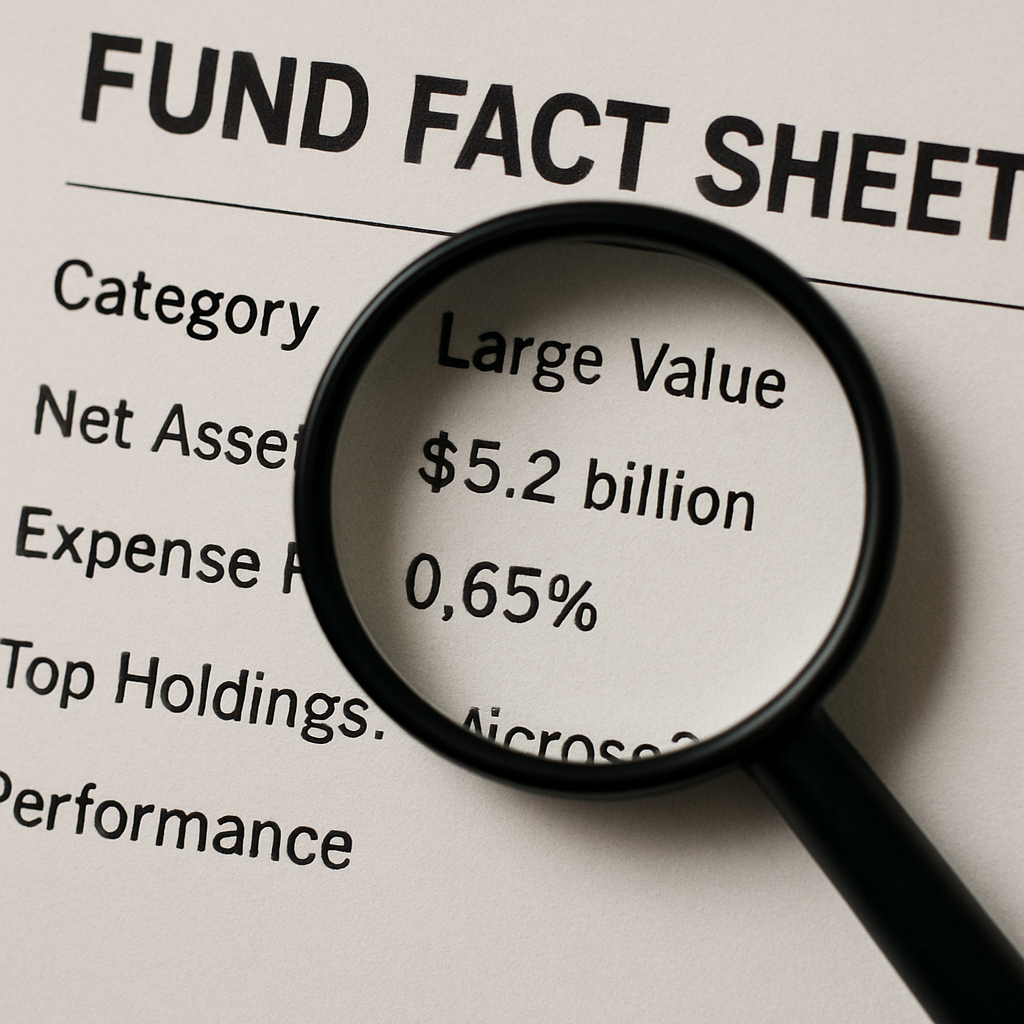
Walking down the grocery aisle, you wouldn’t buy a box of cereal without glancing at the nutritional label. Evaluating an investment works exactly the same way. Every fund provides a Fund Prospectus—a formal document acting as the product’s ingredient list—but you don’t need to read fifty pages of legal jargon to find the lowest-cost ETFs.
Before putting anything into your cart, run the investment through this quick three-step smart shopper checklist:
- Ticker Symbol: This is the fund’s unique barcode (like “VOO” or “IVV”), usually three to four letters long, used to look up its price.
- Expense Ratio: Your annual maintenance fee. Look at the fund’s summary page to verify this number is a tiny fraction of a percent.
- Holdings: This reveals the actual companies inside the basket, which is essential information for understanding how to build a balanced portfolio.
When comparing Vanguard and iShares, two of the largest “supermarket brands” in investing, you will quickly notice their standard index funds offer nearly identical ingredients with equally microscopic fees. Once you know how to read these simple digital price tags, the final step is walking up to the register and choosing a commission-free platform.
Where to Shop: Choosing a Commission-Free Home for Your ETFs
Figuring out exactly where to buy ETF shares requires stepping outside your regular neighborhood bank. To purchase these funds, you need a brokerage account, which is essentially a specialized digital supermarket designed specifically for investments. While your standard checking account holds your everyday cash, this new account acts as the dedicated shopping cart for your financial future.
Once you open that digital cart, the next logical question is how you can buy ETF shares without losing money at the register. Just a few years ago, Wall Street charged a “commission”—a steep toll booth fee every time you clicked the buy button. Today, the best commission-free brokerages have completely eliminated these transaction fees, meaning your entire deposit goes directly toward your actual investment.
Even with free trading, smart shoppers must stay vigilant against hidden account maintenance costs. Always verify your chosen platform doesn’t charge a monthly penalty simply for keeping your money parked there. With a fee-free platform selected and your preferred funds picked out, you are ready to launch your financial strategy.
Your Low-Cost Launchpad: A 3-Step Plan for Financial Freedom
You no longer have to guess where your savings are going. After all, does it make sense to pay someone 1% of your entire net worth just to click a “buy” button for you?
Think of DRIP (Dividend Reinvestment) as an auto-pilot button for your money. When your fund pays out earnings, this setting automatically uses that cash to buy you more slices. To build a balanced portfolio, use this straightforward checklist for cost-effective retirement planning:
- Open a brokerage account.
- Search for your low-cost ETF ticker.
- Turn on DRIP.
Coupled with rock-bottom fees, these automated dividend reinvestment strategies quietly act as a snowball, multiplying your wealth over time. Start with that first simple purchase to see immediate progress, and let your money finally work for you.