
Most people don’t realize the government takes a cut of the interest earned in an everyday bank account. According to federal tax guidelines, those extra dollars the bank pays you are treated as taxable income. Fortunately, a specific account exists to keep the IRS off your gains forever.
Navigating the Roth IRA vs savings account debate is easier when you picture two different containers. Your savings account is a leather wallet: perfect for cash needed tomorrow for an emergency tire replacement, but not built for wealth. A Roth IRA acts as a sturdy vault for retirement savings for beginners. It is just an empty bucket holding your money while it grows, shielded entirely from future taxes.
Leaving all your cash sleeping in that wallet feels safe, but industry data reveals inflation quickly outpaces standard bank profits. You do not need thousands of dollars to protect your future right now. By unlocking these tax-free growth advantages, even fifty dollars a month snowballs into a massive safety net, proving that doing nothing is actually the riskiest move of all.
The Savings Account: A Secure ‘Wallet’ for Your Immediate Needs
Life rarely goes exactly to plan, which is why your financial foundation must start with a safety net. This net is called an emergency fund. A solid rule of thumb is to save enough cash to cover three to six months of your basic living expenses. This money gives you peace of mind when things inevitably go wrong.
Where should you keep this cash? You need a reliable bank because the liquidity of savings accounts means you can get your money out immediately. This rapid, guaranteed access makes a savings account the only right choice for specific life events:
- A sudden car repair.
- An unexpected medical bill.
- A cash buffer against sudden job loss.
Using a high-yield savings account is the secret to building an emergency fund faster. A High-Yield Savings Account (HYSA) works exactly like a regular, safe “wallet,” but these banks pay you significantly more “rent” (interest) for keeping your money there. This extra, automatic profit helps protect your cash from everyday rising prices.
Keeping your safety net in an HYSA protects you today, but it will not make you wealthy tomorrow. While your savings account acts as a secure wallet for right now, you need a completely different container to grow your money for the distant future.
The Roth IRA: A ‘Tax-Free Vault’ for Your Future Wealth
When you are ready to look past tomorrow’s emergencies, your money needs a different home. Think of a Roth IRA not as a specific stock you buy, but simply as a heavy-duty vault. You put cash inside this vault, and then use it to buy investments that grow over decades. In comparing these accounts, the bank is your open wallet for today, while the IRA is a locked vault for your distant future.
Everyone knows the frustration of seeing taxes instantly pulled from a paycheck. That familiar sting is actually what makes this vault so powerful, creating massive post-tax contribution benefits. Because you have already paid taxes on the money going into the account today, the government legally agrees to never touch it again.
Letting your cash snowball inside this tax shield highlights the biggest difference between a retirement account and emergency savings. If your investments grow from $5,000 to $50,000 over twenty years, every single penny of that profit is yours to keep. You can pull it out in retirement completely tax-free.
Setting up this vault is just the beginning; the real magic happens when you decide what goes inside. If both accounts just held cash, their balances would barely differ. So, why do IRAs earn more? Comparing interest against market growth reveals how the investments inside your vault actually multiply.
Why Do IRAs Earn More? Understanding Interest vs. Market Growth
Many beginners ask, “do IRAs earn interest like a regular bank account?” The short answer is no. When people wonder, “does an IRA account earn interest,” they are usually thinking of the tiny “rent” payments banks give you for holding your cash. Instead, a Roth IRA is a vault that holds actual investments, which have the potential to grow significantly faster than basic savings.
Playing it entirely safe hides a quiet risk: inflation. Every year, everyday items like groceries get more expensive. When evaluating a bank’s annual percentage yield vs market returns, standard bank payouts rarely keep up with these rising prices. Investing puts your money to work in the market, protecting your purchasing power so your cash doesn’t slowly lose value while sitting still.
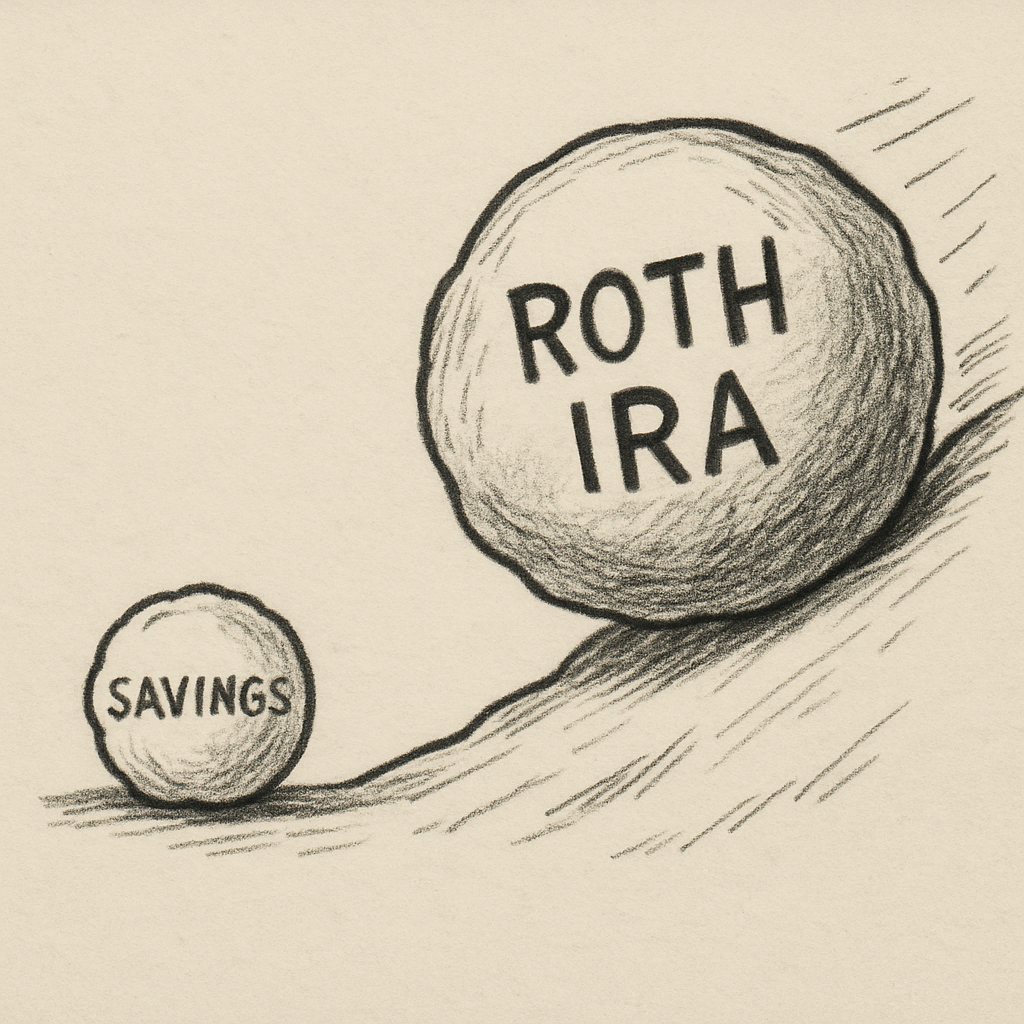
The real magic happens through compound interest over time. Think of your money as a snowball rolling down a long hill, picking up more snow as it goes. Here is how a single $1,000 deposit compares after ten years:
- Savings Account (0.5% rate): Grows to about $1,051. You earned $51.
- Roth IRA (7% average return): Grows to about $1,967. You almost doubled your money.
Watching your wealth multiply makes investing incredibly appealing. However, because the government provides massive tax benefits to help you build this future wealth, they prefer you let the snowball keep rolling. But what happens if life throws a curveball and you suddenly need that cash back today?
Can You Touch Your Money? Managing Early Withdrawals and Penalties
Life rarely goes according to plan, which is why the instant access—or liquidity of savings accounts—feels incredibly safe. You can easily transfer cash at midnight to pay for a broken water heater. Consequently, using a Roth IRA for short-term goals usually isn’t the best plan. The government designed IRAs for retirement, attaching strict rules if you try to open the vault too soon.
Fortunately, a special loophole makes the Roth IRA much more flexible than most realize. Remember the difference between what you deposited (your contributions) and what the market added (your earnings)? You can withdraw your original contributions anytime, completely tax-free. The trap only springs shut if you try to touch the profits too early, triggering steep tax penalties for early withdrawals.
Staying out of trouble with the IRS simply requires following these three clear boundaries:
- Your original money (the principal) is always yours to withdraw penalty-free.
- Taking out your investment profits (the earnings) before age 59½ usually triggers a heavy 10% penalty.
- Replacing withdrawn money is highly restricted, so only remove cash if absolutely necessary.
2024 Contribution Limits and Rules: How Much Can You Actually Save?
When choosing between these accounts, one massive difference is how much cash you can actually deposit. Your local bank is thrilled to let you park an unlimited amount of money in a standard savings wallet. However, because tax-free growth is an incredibly powerful tool for long-term wealth building strategies, the government strictly caps how much you can put into your retirement vault each year.
For most people, the Roth IRA contribution limits for 2024 max out at exactly $7,000. Broken down, this means you can transfer about $583 a month to put to work. Older savers get a slight bonus; if you are 50 or older, the IRS allows you to add an extra $1,000 to help you catch up before you stop working.
Earning a high salary can change these rules, introducing what the IRS calls an income limit. If you make over $146,000 as a single person in 2024, the government starts shrinking that $7,000 allowance, eventually dropping it to zero.
Your 3-Step Plan to Balancing Growth and Security
You no longer have to guess where your extra cash belongs. Now that you understand the strengths of each account, you can confidently balance your “Right Now” security with your “Future You” wealth. Mastering emergency funds while starting retirement savings is exactly what transforms you from a simple saver into a lifelong wealth builder. Here is the hierarchy for your next $100:
- Build a 1-month ‘Starter’ emergency fund
- Open a Roth IRA with as little as $50
- Automate your monthly ‘vault’ deposit
This transition doesn’t require thousands of extra dollars or a complex finance degree—it just takes one automated step. Once you set these habits in motion, your money does the heavy lifting for you. Your snowball is ready to roll down the hill, and you are officially ready to build your tax-free future.